At VL Energy, our mission is to harness advanced technologies to deliver innovative solutions that improve efficiency, reduce costs, and drive sustainability in energy production. Our collaboration with the University of Calgary on the Gas Turbine Optimization Project represents a cornerstone of this mission.
In 2024, the partnership achieved a significant milestone with the successful completion of Phase 1, where we applied artificial intelligence to accurately predict gas turbine power output and optimize performance. Today, we are excited to share the achievements of Phase 2, which focused on developing and validating a predictive system for greenhouse gas (GHG) emissions—an advancement that has both regulatory and financial implications for the energy industry.
Project Overview
The Gas Turbine Optimization Project is structured in three stages:
- Phase 1 (completed in 2024): Development of AI models to predict turbine power output with high accuracy (R² = 0.977 during testing), achieving up to a 30% improvement in generated power.
- Phase 2 (2025, nearing completion): Application of advanced machine learning to predict GHG emissions—specifically CO₂, CH₄, and N₂O—using data already collected by the plant’s existing sensors and equipment.
- Phase 3 (upcoming): Active optimization of turbine operations, with the goal of minimizing GHG emissions and maximizing efficiency in real time.
Phase 2 represents a critical step forward because it validates ES-PEMS as more than a performance tool. It establishes predictive monitoring as a compliance-ready solution that can meet regulatory standards, reduce costs, and pave the way for optimization strategies in Phase 3.
Achievements of Phase 2
Successful Real-World Validation
The first major achievement of Phase 2 was the successful deployment of a proof-of-concept Efficient & Secure Predictive Emissions Monitoring System (ES-PEMS) at the University of Calgary’s heating plant. The goal was to test whether machine learning models could use existing operational data to accurately predict emissions without the need for additional hardware or costly Continuous Emissions Monitoring Systems (CEMS).
This validation was a success. By proving that predictive models can be integrated into existing plant infrastructure, the project demonstrates a scalable, cost-effective pathway for operators seeking both regulatory compliance and financial efficiency. This breakthrough also sets the stage for broader adoption, particularly in industrial contexts where emissions monitoring requirements are stringent and continuous improvement is a priority.
Robust Data Collection & Model Development
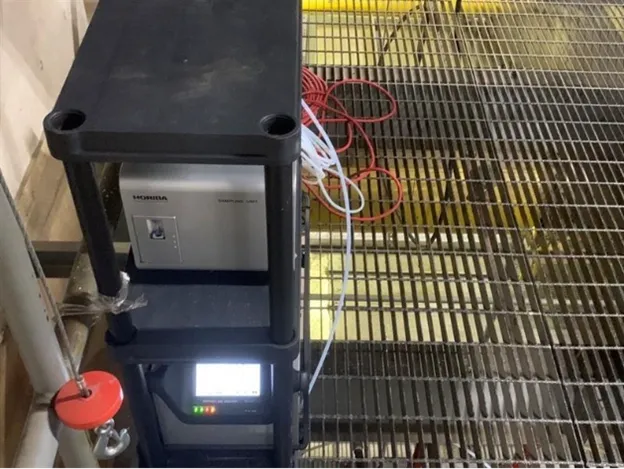
Data is the foundation of predictive accuracy. For this phase, emissions data was temporarily collected using a calibrated gas analyzer, providing a high-quality baseline for validating predictions.
This emissions data was combined with a comprehensive dataset from the plant’s operational systems. In total:
- 215 operational parameters (covering everything from temperature and fuel flow to load conditions)
- 20 sensors continuously tracking plant performance
This large, multidimensional dataset enabled the development of machine learning models that are robust, adaptable, and capable of predicting emissions across varying operating scenarios.
Importantly, the approach ensures that the model is not “overfitted” to specific conditions but can generalize across the real-world variability inherent in turbine operations. By embedding predictive intelligence into standard plant data, ES-PEMS positions itself as both practical and scalable.
High Predictive Accuracy
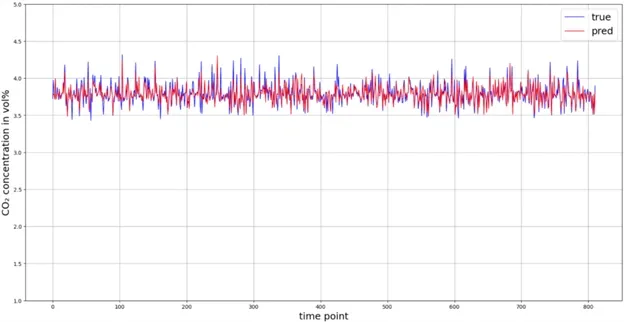
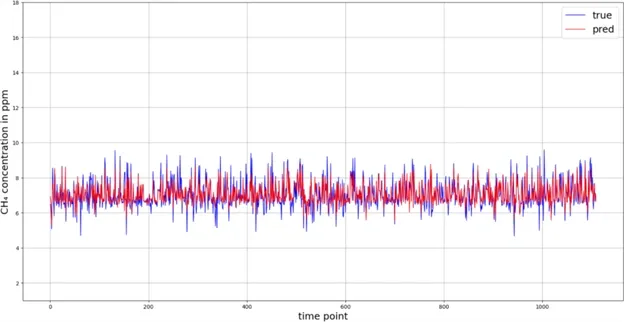
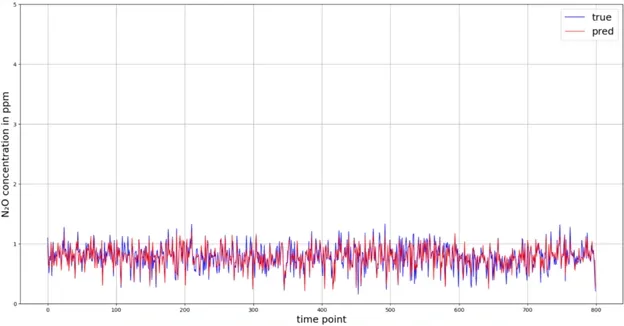
The Phase 2 ES-PEMS model demonstrated robust predictive performance, meeting or exceeding the compliance thresholds set by the U.S. EPA PS-16 and Alberta AEP/AER (R² ≥ 0.64).
These results not only match but exceed compliance standards. Both the U.S. Environmental Protection Agency (EPA) PS-16 and the Alberta AER/AEP set an R² threshold of 0.64 for compliance acceptance. Achieving higher values for CO₂ and N₂O, and meeting the threshold for CH₄, validates ES-PEMS as a compliance-grade solution.
This accuracy is especially significant given the diverse challenges in predicting GHGs. While CO₂ is the most abundant and relatively stable, methane and nitrous oxide present more variability due to their trace quantities. Achieving regulatory-level predictive power across all three gases underscores the strength of the model design and dataset.
Tangible Financial Impact
Phase 2 results also demonstrate that ES-PEMS is not just a compliance tool—it is a driver of financial efficiency.
To measure real-world impact, we compared:
- Audited TIER data from April 24–May 23, 2023
- PEMS-predicted emissions for the same period in 2025
The results revealed meaningful reductions:
- 578 tonnes of CO₂
- 0.039 tonnes of CH₄
- 0.0049 tonnes of N₂O
- Total reduction: 580 tonnes CO₂e
At the carbon credit trading price of $65 per tonne of CO₂e, these reductions translate to:
- $37,726 in avoided carbon credit costs over 28 days
- An estimated $483,730 in annualized cost savings
These savings are not theoretical. They are rooted in real plant data and validated against historical baselines. Analysis of emissions from 2021–2024 showed a consistent mean of 60,802 tCO₂e ±5%, confirming that operational conditions have remained stable. The improvement is therefore a direct result of PEMS accuracy, not changes in plant activity.
This finding establishes ES-PEMS as a proven cost-saving mechanism, adding financial value alongside compliance assurance.
Operational & Strategic Benefits
The outcomes of Phase 2 extend far beyond technical validation. By proving that predictive models can achieve compliance-grade accuracy, the project has delivered a number of operational and strategic benefits that directly impact both day-to-day efficiency and long-term planning.
Enhanced Accuracy in TIER Compliance Reporting
ES-PEMS strengthens confidence in emissions reporting by providing more precise, data-driven predictions. This improvement reduces the risk of reporting discrepancies, audit challenges, or penalties—ensuring organizations remain in full compliance with Alberta’s TIER framework and other regulatory standards.
Reduced Reliance on Costly CEMS
Traditional Continuous Emissions Monitoring Systems (CEMS) require significant capital investment and ongoing maintenance. By leveraging data already captured through existing sensors, ES-PEMS minimizes dependence on these costly systems, offering a cost-effective and scalable alternative that still meets regulatory thresholds.
Foundation for Phase 3 Optimization
Perhaps most importantly, Phase 2 has established the technical groundwork for the next stage of the project: using predictive insights not just for compliance, but for active operational optimization. This foundation will enable the system to recommend or even automate real-time adjustments that directly reduce greenhouse gas emissions, transforming reporting into action.
Together, these benefits highlight ES-PEMS as more than a compliance tool—it is a strategic enabler that bridges regulatory assurance, operational efficiency, and long-term sustainability goals.
Looking Ahead: Phase 3 and Beyond
With Phase 1 and Phase 2 successfully completed, the Gas Turbine Optimization Project now moves toward Phase 3: optimization for emissions reduction. This stage will take ES-PEMS from prediction to action, applying real-time insights to adjust turbine operations in ways that directly reduce greenhouse gas emissions at the source.
Where Phase 2 established the credibility of predictive monitoring for compliance and cost savings, Phase 3 will demonstrate its role as an active optimization tool—helping operators achieve both environmental stewardship and operational excellence.
The broader implications extend beyond this single project. As carbon pricing, regulatory requirements, and sustainability pressures continue to rise, tools like ES-PEMS will become central to energy and industrial operations. By integrating compliance, cost management, and emissions optimization into a single system, ES-PEMS offers organizations a strategic pathway toward net-zero goals.