As the world intensifies its focus on environmental sustainability, businesses are increasingly expected to measure and reduce their carbon emissions. However, it can be daunting to navigate the complex landscape of emission benchmarking, baselines, and their correlation with a carbon tax, carbon credits, and Scope 1, 2, and 3 emissions. At VL Energy, we recognize the significance of these concepts and their role in a low carbon economy. In this blog post, we will explore the fundamentals of emission benchmarking, baselines, and their broader implications, providing insights for businesses seeking to adopt sustainable practices.
Emission Benchmarking/Baselines
Emission benchmarking is the process of comparing an organization's greenhouse gas emissions performance against established standards, industry averages, or best practices. The process involves analyzing and evaluating emission data from a company's operations and comparing it to similar data from other organizations within the same industry or sector. Benchmarking plays a crucial role in driving environmental performance improvements across industries by fostering healthy competition and encouraging companies to adopt more sustainable practices.
Baselines serve as the starting point for emission tracking and reduction initiatives. They are typically established by calculating an organization's historical emissions or developing industry-specific standards. Baselines allow companies to set realistic reduction targets and track their progress toward achieving sustainability goals.
The Role of Carbon Tax
The carbon tax is an economic instrument aimed at reducing greenhouse gas emissions by imposing a financial cost on carbon-intensive activities. It encourages businesses to internalize the environmental costs associated with their emissions. Emission benchmarking and baselines play a crucial role in determining the appropriate tax amount based on an organization's emissions relative to the established standards.
Scope 1, 2, 3 Emissions
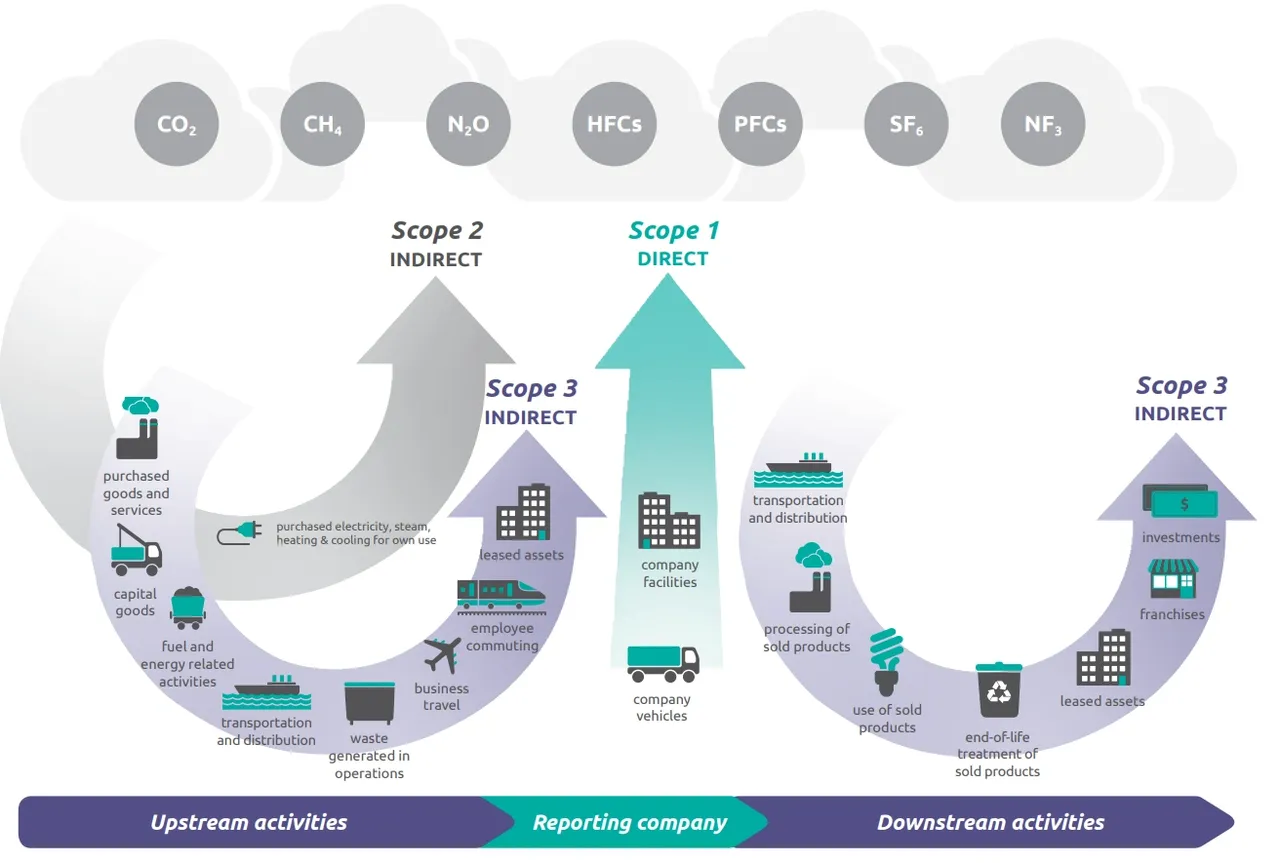
- Scope 1: Encompasses direct GHG emissions from an organization's owned or controlled sources, such as on-site fuel combustion and company vehicles.
- Scope 2: Involves indirect emissions from purchased electricity, heating, or cooling for own use.
- Scope 3: Goes beyond a company's direct operations, accounting for emissions from its entire value chain, including suppliers, customers, and transportation. This can be categorized as indirect (leased assets, purchased goods and services, waste generated in operations, business travel, etc.) or indirect downstream activities (use of sold products, end-of-life treatment of sold products, franchises, investments, transportation, etc.)
Leveraging Emission Benchmarking and Baselines for Sustainability
Implementing effective emission benchmarking and establishing reliable baselines can significantly impact a company's sustainability efforts. By adopting the right technologies and strategies to monitor and reduce emissions, businesses can mitigate financial risks associated with carbon taxes and enhance their eligibility for carbon credits.
Utilizing VL Energy's Technology for Accurate Emissions Data
VL Energy offers a technology called ES-PEMS (EmissionSight's Predictive Emissions Monitoring System), which monitors and measures ground truth emissions data. By utilizing this technology, companies can effectively control and employ baselines and benchmarks that accurately reflect their emissions and facilitate progress toward emissions goals.
At VL Energy, we believe that emission benchmarking, baselines, and effective emissions tracking play a pivotal role in shaping a low-carbon future. By understanding these concepts and their influence on the carbon tax, carbon credits, and Scope 1, 2, and 3 emissions, businesses can take proactive steps toward environmental stewardship while simultaneously reaping financial benefits.
By accurately measuring and monitoring emissions, companies can make informed decisions, set ambitious reduction targets, and contribute to a more sustainable future. VL Energy is committed to providing innovative solutions to support organizations in their emission management journey, driving positive change for both the environment and their bottom line.