Steam Assisted Gravity Drainage (SAGD) is a crucial technique used in oil sand extraction, particularly in regions like Alberta where viscous bitumen cannot be pumped directly from the ground. This process involves the injection of steam to heat the bitumen, allowing it to flow to a production well. While effective, SAGD is energy-intensive and can significantly impact the environment through emissions. However, integrating Predictive Emissions Monitoring Systems (PEMS) into the central processing facilities of SAGD operations offers a promising solution to enhance operational efficiency and reduce environmental impact.
How SAGD Works
- Drilling and Well Setup: A pair of 1 km long horizontal wells are drilled, one positioned roughly 5 meters above the other, from a central well pad.
- Steam Generation: A nearby plant recycles, cleans, and heats salty (not fresh) water to generate steam.
- Steam Injection: The steam travels through pipelines to the well pair and is injected into the upper well. This steam heats the bitumen, reducing its viscosity so that it can flow by gravity into the lower-producing well.
- Continuous Process: The steam injection and bitumen production occur simultaneously and continuously, ensuring a steady flow of bitumen.
- Bitumen Extraction: The resulting mixture of oil and condensed steam is piped from the producing well back to the plant, where it is separated and treated. The produced water is then recycled to generate new steam.
The Role of PEMS in SAGD
PEMS utilizes advanced algorithms and machine learning to predict and monitor emissions accurately, providing real-time data that is crucial for operational decision-making. By implementing PEMS in the central processing facilities, particularly in cogeneration units, operators can gain several advantages:
- Improved Emissions Monitoring: PEMS provides continuous, real-time tracking of emissions, including greenhouse gases like CO₂, CH₄ and N₂O. This precision allows for immediate adjustments in operations, ensuring compliance with environmental regulations and reducing the risk of fines or shutdowns due to non-compliance.
- Operational Efficiency: By analyzing data from PEMS, facility operators can optimize steam generation and utilization, reducing fuel consumption and minimizing wastage. This not only cuts operational costs but also decreases the carbon footprint of the extraction process.
- Predictive Maintenance: PEMS can forecast potential equipment failures by analyzing trends and anomalies in emission data. This foresight allows for timely maintenance, preventing unexpected breakdowns that could halt production and lead to costly repairs.
- Reduce Emissions: In cogeneration units used within SAGD facilities, PEMS have a critical role in reducing emissions. By continuously monitoring and predicting the emissions output, PEMS enables operators to make data-driven adjustments to the combustion process. This optimization leads to a more efficient burn, reducing the quantity of fuel needed and consequently lowering the emissions of SOₓ, NOₓ, and other pollutants. The capability of PEMS to fine-tune operational parameters in real-time not only ensures adherence to environmental standards but also significantly cuts down on greenhouse gas emissions. This is particularly vital in operations like SAGD where the energy intensity can have large-scale environmental impacts.
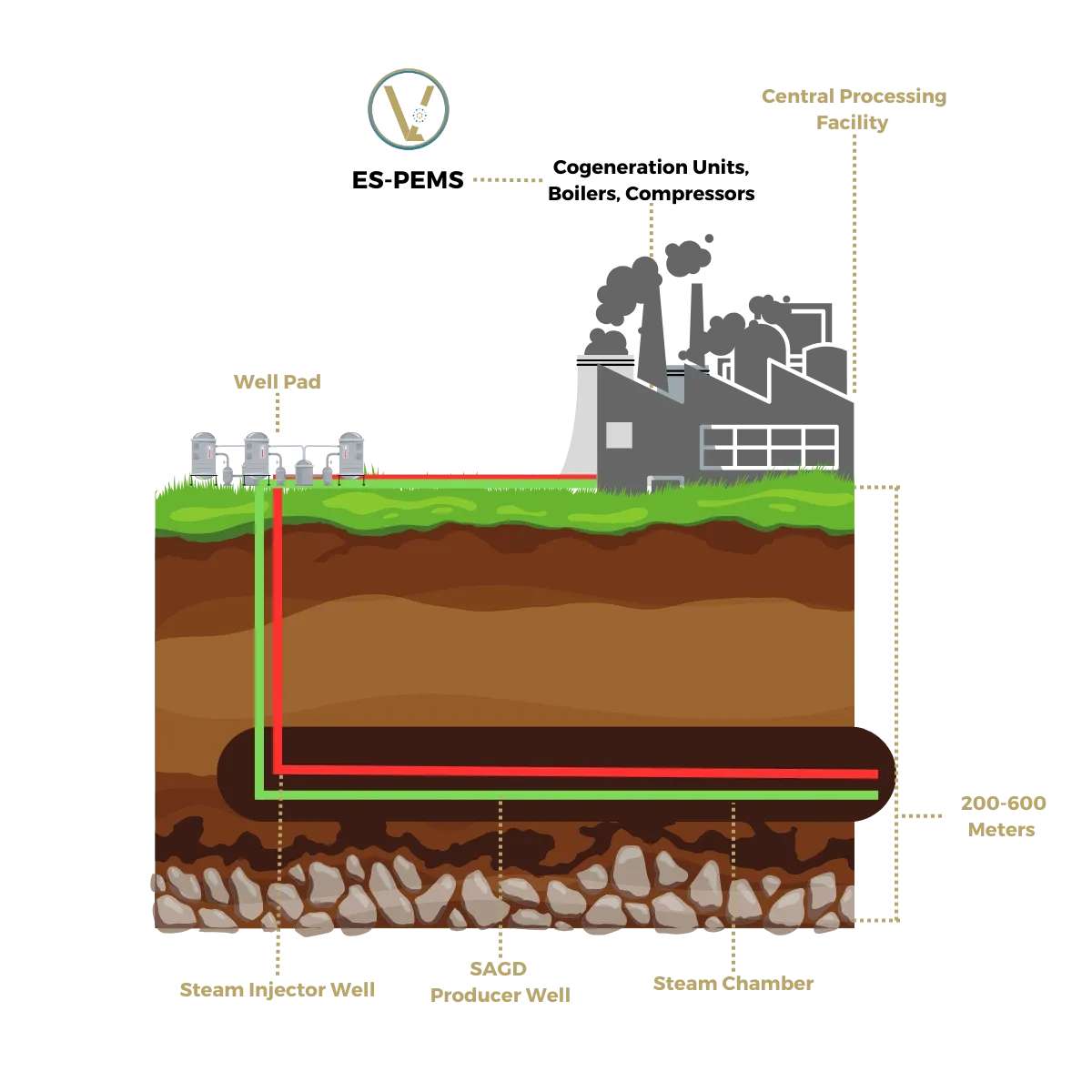
ES-PEMS & The Facility Breakdown
- ES-PEMS: VL Energy’s ES-PEMS (Efficient and Secure Predictive Emission Monitoring System) collects data from equipment like boilers, cogeneration units, compressors or pumps in the Central Processing Facility. ES-PEMS utilizes machine learning, artificial intelligence and cloud computing to monitor, measure, predict and reduce emissions in REAL-TIME. This software is not physical equipment that needs to be calibrated, it is software with low costs, limited maintenance and the ability to improve operations and on-site health and safety with real-time alerts.
- Central Processing Facility: This is where the steam is generated and emissions are monitored. The facility includes cogeneration units, boilers, and compressors, which are all part of the system to produce steam or handle the bitumen after extraction.
- Well Pad: The location where the wells are drilled. In this setup, there are typically two horizontal wells; one is an upper steam injector well, and the other is a lower producer well.
- Steam Injector Well: This well injects steam deep underground to heat the bitumen, making it fluid enough to be pumped out. The steam reduces the viscosity of the bitumen, allowing it to flow into the producer well.
- Steam Chamber: The area in the reservoir where bitumen is heated and becomes fluid. The injected steam forms a chamber as it heats the bitumen around the injector well.
- SAGD Producer Well: Positioned below the injector well, this well collects the heated bitumen and water mixture, which is then pumped back to the surface.
Conclusion
Incorporating PEMS into SAGD operations aligns with the increasing environmental regulations and offers substantial economic benefits by enhancing efficiency and reducing operational risks. As the oil and gas industry continues to seek sustainable solutions, technologies like PEMS represent a significant step forward in balancing energy production with environmental stewardship.