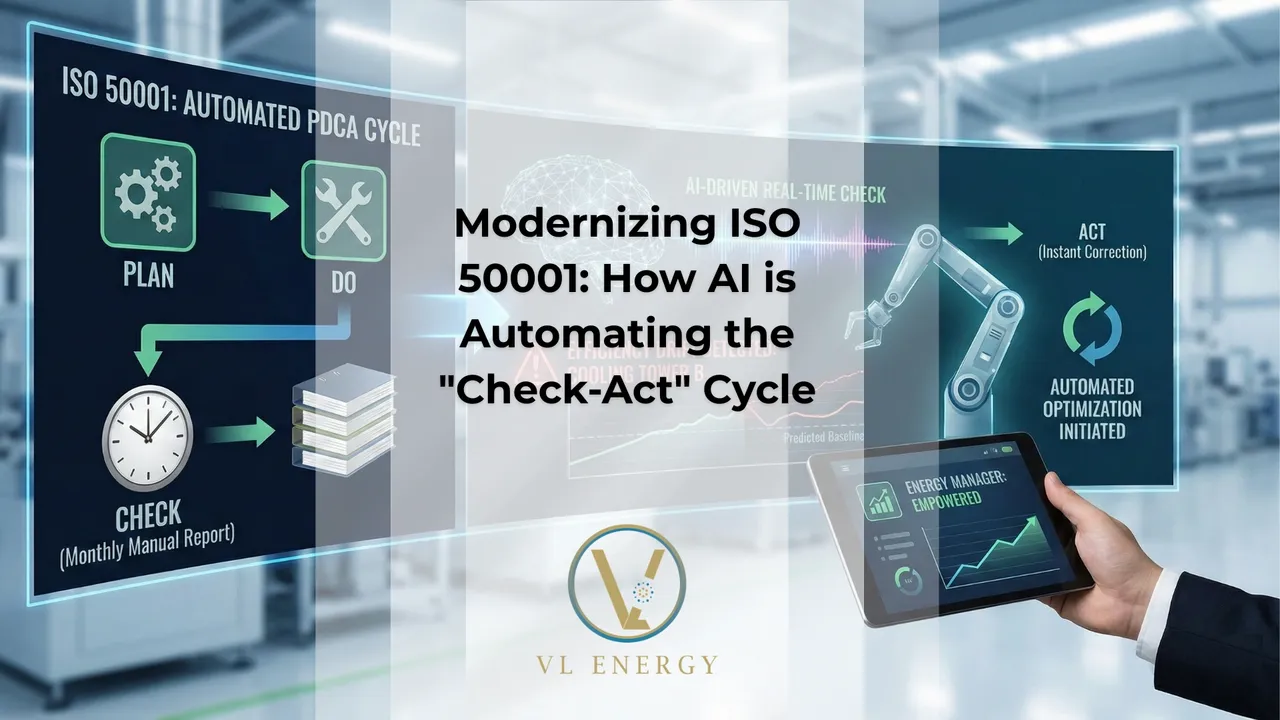
For decades, energy management standards have provided a structured framework for industrial and commercial organizations to optimize their resource consumption. At the heart of the most recognized global standard, ISO 50001, lies the "Plan-Do-Check-Act" (PDCA) cycle. This iterative process is designed to foster continuous improvement, ensuring that energy performance does not merely stagnate after an initial efficiency project but continues to evolve. However, in the traditional implementation of this standard, the "Check" phase has often been a bottleneck—a retrospective exercise limited by manual processes and static tools.
As we enter the age of Artificial Intelligence, the fundamental mechanics of the PDCA cycle are being rewritten. We are moving away from a world where energy managers react to month-old spreadsheet data and toward a paradigm where energy management systems (EMS) function as proactive, real-time partners.
From Static Baselines to Dynamic Models
The foundation of any energy performance assessment is the baseline—the reference point against which current consumption is measured. Historically, establishing this baseline involved gathering historical data and creating a linear regression model using basic variables like heating degree days or production output. While functional, these static baselines often fail to capture the complexity of modern operations. They struggle to account for non-linear variables, such as humidity, shift changes, or complex equipment interactions.
AI transforms this foundational step by replacing static calculations with dynamic, multi-variable models. Machine learning algorithms can ingest vast amounts of historical and real-time data to create a "digital twin" of the facility’s energy profile. These models predict exactly how much energy ‘should’ be consumed at any given moment under current conditions. Instead of comparing this month’s bill to last year’s average, the system compares real-time consumption against a precise, dynamic prediction, revealing inefficiencies that a static spreadsheet would simply miss.
The "Always-On" Energy Auditor
The most significant shift AI brings to ISO 50001 is the automation of the "Check" phase. Traditionally, this phase was a periodic event. Once a month, an energy manager would aggregate data, populate a report, and look for anomalies. If a cooling system began drifting out of calibration on the third day of the month, the inefficiency would continue unnoticed for weeks until the "Check" phase occurred. By then, the energy—and the money—was already wasted.
AI-driven systems act as an "always-on" auditor. They automate the "Check" phase by monitoring performance streams continuously. When actual consumption deviates from the dynamic model’s prediction, the system flags the anomaly instantly. This shifts the operational reality from reactive to immediate. Operators are alerted to efficiency drift the moment it happens, allowing for corrections to be made within the "Act" phase in real-time. The cycle tightens from a monthly loop to an instantaneous feedback loop, ensuring that energy performance indicators (EnPIs) remain within their optimal range.
Data Integrity: The Hidden Foundation
For any automated system to function effectively, the fuel—data—must be pure. In manual systems, human intuition often acts as a filter for bad data; a manager might ignore a meter reading they know is faulty. In an automated AI environment, data integrity is paramount. If the system is fed erroneous data, the "Check" phase will produce false positives or miss critical failures.
Modern solutions address this by embedding data quality assurance directly into the collection layer. AI algorithms are not just analyzing energy usage; they are also analyzing the health of the metering infrastructure itself. They can detect frozen sensors, calibration errors, or communication dropouts, ensuring that the "Check" phase is based on verified, high-quality information. This automated validation provides the rigorous evidence required for certification audits, reducing the administrative burden of proving data reliability.
Empowering the Energy Manager
There is a fear that automation renders human expertise obsolete, but in the context of ISO 50001, the opposite is true. By automating the tedious data collection and "Check" analysis, AI liberates the energy manager from the role of data entry clerk. Instead of spending days consolidating spreadsheets to find out what happened, the manager starts their week knowing exactly where the issues are.
This shift empowers the energy manager to focus on the "Act" and "Plan" phases—strategic initiatives, capital project planning, and behavioral change management. The manager becomes a strategist rather than an analyst, using the insights provided by the AI to drive high-value decisions that permanently reduce the facility's carbon footprint and operational costs.
Conclusion
Modernizing ISO 50001 is not about changing the standard itself, but about upgrading the tools we use to achieve it. By integrating AI, organizations can transform the "Check-Act" cycle from a periodic compliance exercise into a continuous, automated engine for efficiency. In this new era, energy management becomes proactive, data-driven, and relentlessly efficient, bridging the gap between compliance and genuine sustainability.