In today’s industrial landscape, accurate and reliable emissions monitoring is no longer optional—it’s essential. Regulatory pressures are increasing, and organizations face mounting demands to track, report, and reduce greenhouse gas (GHG) emissions efficiently. Whether for regulatory compliance, environmental responsibility, or operational optimization, companies need a system that is accurate, secure, and adaptable to their unique infrastructure.
VL Energy’s Efficient and Secure Predictive Emissions Monitoring System (ES-PEMS) addresses these needs by combining cutting-edge AI technology, robust cloud architecture, and deep regulatory expertise. This ensures companies not only meet compliance requirements but also gain actionable insights to optimize operations and reduce costs.
Why ES-PEMS Are Becoming the Global Standard
Historically, Continuous Emissions Monitoring Systems (CEMS) have been the primary method for tracking industrial emissions. While effective, these systems require significant hardware investment, ongoing maintenance, and complex installation procedures. They can also be slow to deliver actionable data, leaving operators with delayed insights.
Predictive Emissions Monitoring Systems (ES-PEMS) offer a modern alternative. Instead of relying solely on physical sensors, ES-PEMS combines operational data, fuel consumption metrics, and equipment specifications with advanced algorithms to predict emissions in near real-time. This approach reduces reliance on heavy infrastructure while improving data reliability and scalability.
Industries worldwide are rapidly adopting ES-PEMS for several reasons:
- Cost Efficiency: Minimal hardware and maintenance requirements translate to lower capital and operating costs.
- Rapid Deployment: ES-PEMS can be implemented in weeks, not months, reducing operational downtime.
- Regulatory Compliance: Systems are designed to meet or exceed international monitoring standards, easing reporting burdens.
- Actionable Insights: AI-driven analytics help identify inefficiencies, optimize fuel use, and reduce emissions proactively.
Leading ES-PEMS Around the World
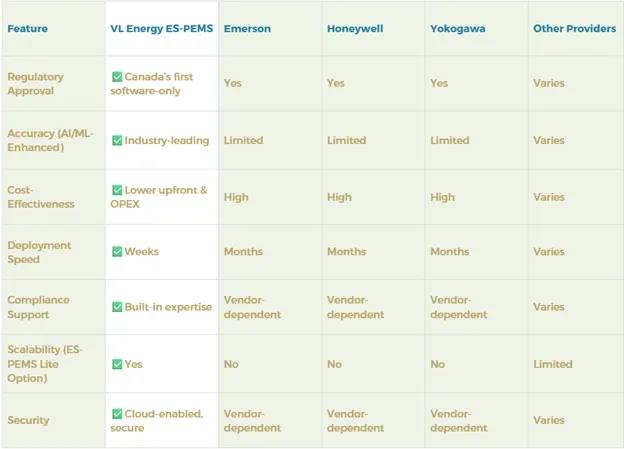
Several global players have established predictive emissions monitoring systems, including Emerson, Honeywell, and Yokogawa. These systems are recognized for robust performance and reliability. However, they often come with significant limitations:
- High Cost: Implementation and ongoing operational costs are typically high.
- Limited Flexibility: These systems may not easily adapt to smaller or non-standard sites.
- Slow Deployment: Full integration can take months, delaying access to real-time data.
- Vendor Dependency: Compliance support and updates often depend heavily on the vendor, creating reliance risk.
What Makes VL Energy Different
VL Energy’s ES-PEMS stands out as a forward-thinking solution that addresses the limitations of traditional systems while enhancing efficiency, security, and compliance support. Key differentiators include:
- Accuracy: By leveraging AI and machine learning, VL Energy’s ES-PEMS delivers predictive emissions data validated through multiple pilots with organizations such as the University of Calgary, Suncor, and Cenovus. The system learns from operational patterns to continuously refine predictions.
- Security: ES-PEMS is designed with data integrity and cybersecurity in mind. Cloud-enabled architecture ensures that emissions data is securely transmitted, stored, and accessed only by authorized personnel, meeting modern data protection standards.
- Speed: VL Energy’s lightweight, software-first system allows deployment in weeks rather than months, enabling organizations to start monitoring and optimizing emissions quickly.
- Compliance Support: VL Energy holds Canada’s first regulatory-approved software-only ES-PEMS, offering clients confidence that they meet evolving environmental standards without complex modifications or upgrades.
- Scalability: From large enterprise facilities to smaller industrial sites, VL Energy offers ES-PEMS Lite, a streamlined version that generates accurate emissions estimates without requiring heavy instrumentation. This flexibility allows organizations to scale their emissions monitoring as needs evolve.
Side-by-Side Feature Comparison
Benefits for Industry Leaders
Implementing VL Energy’s ES-PEMS provides tangible advantages:
- Operational Optimization: Predictive insights allow operators to identify inefficiencies, optimize fuel usage, and reduce greenhouse gas output.
- Regulatory Confidence: Compliance is simplified, with built-in regulatory reporting that ensures alignment with Canadian and international standards.
- Cost Reduction: Reduced hardware requirements and cloud-based monitoring lower both capital and operational expenses.
- Future-Readiness: With AI-driven analytics, organizations can adapt to new environmental regulations quickly and efficiently.
Conclusion
As global emissions regulations tighten, predictive emissions monitoring is no longer optional—it’s essential. VL Energy’s Efficient and Secure Predictive Emissions Monitoring System (ES-PEMS) combines accuracy, speed, security, and compliance support to provide industrial operators with a future-ready solution. From enterprise-scale facilities to smaller unregulated sites, ES-PEMS offers a flexible, cost-effective approach to emissions monitoring that outperforms traditional systems.
For companies looking to stay ahead in operational efficiency, environmental responsibility, and regulatory compliance, VL Energy’s ES-PEMS is the trusted partner for the future of emissions monitoring. Contact us today to schedule a demo.