Environmental monitoring is no longer optional—it’s a core part of operational strategy. Companies today must comply with strict regulations, optimize operations, and meet sustainability goals. Yet, many facilities still rely on outdated methods to track emissions.
At VL Energy, we’ve seen firsthand how AI-driven monitoring transforms emissions data, turning messy spreadsheets into actionable insights that drive smarter decisions. Here’s a closer look at what that transformation looks like.
Before AI: The Struggle with Traditional Emissions Monitoring
Imagine this: a mid-sized manufacturing facility collecting emissions data from multiple sources—boilers, generators, storage tanks, and combustion equipment. Without AI, the workflow often looks like this:
- Multiple Data Sources: Flow meters, temperature sensors, pressure gauges, and fuel composition logs are all recorded separately. Engineers spend hours manually consolidating these numbers into spreadsheets.
- Manual Calculations: Emissions are estimated using formulas and manual input, which introduces human error. Small mistakes can cascade into large compliance risks.
- Delayed Reporting: Monthly or quarterly reports are compiled slowly. By the time management reviews the data, it may already be outdated.
- Missed Patterns: Spikes or anomalies in emissions may go unnoticed until after regulatory deadlines, resulting in fines or operational inefficiencies.
Example: One facility reported spending over 60 hours per month manually consolidating emissions data, only to discover inconsistencies that required additional audits.
The Turning Point: Introducing AI-Driven Monitoring
With AI-powered systems like VL Energy’s ES-PEMS, emissions monitoring becomes real-time, accurate, and predictive. Here’s how the workflow transforms:
1. Data Consolidation & Accuracy
AI integrates all data streams—flow, pressure, temperature, fuel composition, and operational metrics—into a unified platform. No more juggling multiple spreadsheets or manual inputs.
Example: A gas-fired power plant had 12 separate sources of data. AI combined these into one dashboard, automatically flagging anomalies and inconsistencies. Accuracy improved by over 30%, and manual data entry time was reduced by 80%.
2. Real-Time Dashboards
Managers and engineers can view emissions trends, key performance indicators (KPIs), and compliance metrics instantly. Instead of waiting weeks for a report, decision-makers have immediate insights.
Example: Previously, a facility would only know about excessive methane leaks after a month. With AI, alerts are sent within minutes, allowing rapid corrective actions.
3. Predictive Analytics
AI doesn’t just report what has happened—it predicts what is likely to happen. Using machine learning models, the system forecasts potential emissions spikes based on operational patterns, weather conditions, and equipment usage.
Example: A refinery used AI to predict a potential CO₂ spike during high-load operations. By adjusting operational parameters proactively, they avoided regulatory violations and optimized fuel usage.
4. Instant Alerts & Actionable Insights
Instead of manually scanning data for errors, AI sends instant notifications when emissions exceed thresholds or unusual patterns are detected. These alerts are paired with suggested corrective actions, enabling fast response.
Example: One facility prevented a methane leak from escalating by receiving a real-time AI alert. Engineers addressed the issue before it resulted in a reportable incident.
5. Efficiency & Cost Savings
Time previously spent manually compiling reports can now be used to optimize operations, reduce emissions, and implement sustainability initiatives.
Example: Across multiple clients, AI monitoring reduced reporting hours by up to 75%, eliminated recurring errors, and improved regulatory compliance confidence.
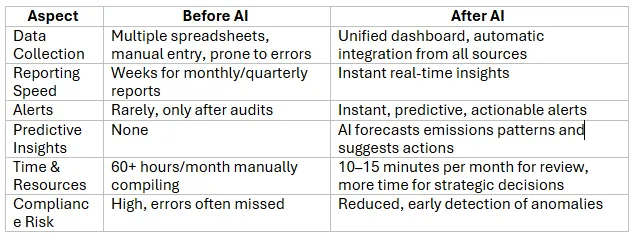
Before vs. After: A Side-by-Side Comparison
Why AI-Driven Monitoring Matters
AI-powered monitoring doesn’t just simplify emissions tracking—it redefines how companies manage their environmental impact:
- Compliance Confidence: Avoid regulatory fines with accurate, real-time data.
- Operational Efficiency: Reduce wasted time on manual reporting and error correction.
- Proactive Management: Predict and prevent emissions spikes before they occur.
- Strategic Insights: Use AI analytics to improve energy efficiency and sustainability outcomes.
Discover how VL Energy can help your facility turn chaos into clarity with AI-powered emissions monitoring. Schedule a demo today.