The push to decarbonize Alberta’s oil sands is driving a massive wave of industrial electrification. Across the province, operators are replacing traditional gas-driven compressors, boiler feed pumps, and mechanical drives with massive electric motors. While this is a critical step toward achieving net-zero emission targets, it introduces an often-overlooked challenge: unprecedented stress on the regional electrical transmission and distribution systems.
Replacing a gas engine with a multi-megawatt electric motor is not a simple plug-and-play exercise. It fundamentally shifts the burden of energy delivery from pipelines to power lines. For the heavy industry sector, navigating this transition requires more than just new copper and larger transformers; it requires predictive intelligence.
The Physical Reality of High-Voltage Electrification
When large-scale industrial facilities undergo electrification, the local electrical grid faces significant operational constraints. The sudden addition of heavy industrial loads can severely stress existing substations, transformers, and switchgears.
Two critical electrical challenges emerge during this transition:
- Peak Demand and Grid Stability: Large electric motors draw immense starting currents and continuous power. If multiple electrified processes ramp up simultaneously, the facility risks establishing a massive coincident peak demand. On the Alberta Electric System Operator (AESO) grid, these peaks not only threaten local grid stability but also result in severe financial penalties through utility demand ratchet charges.
- Power Quality and Reactive Power: To control these large motors efficiently, facilities install large-scale Variable Frequency Drives (VFDs). While VFDs save energy by matching motor speed to the process load, they can introduce harmonic distortion and negatively impact the facility's power factor if not managed correctly. Poor power quality degrades the efficiency of the entire electrical distribution network.
Hardware upgrades to transmission infrastructure are highly capital-intensive and take years to permit and build. To bridge the gap, the energy sector is turning to data.
Machine Learning as a Grid Buffer
The key to successful electrification lies in dynamic load management, powered by advanced Machine Learning (ML) and Artificial Intelligence. By deploying a sophisticated Energy Management Information System (EMIS), facilities can effectively decouple their production demands from grid constraints.
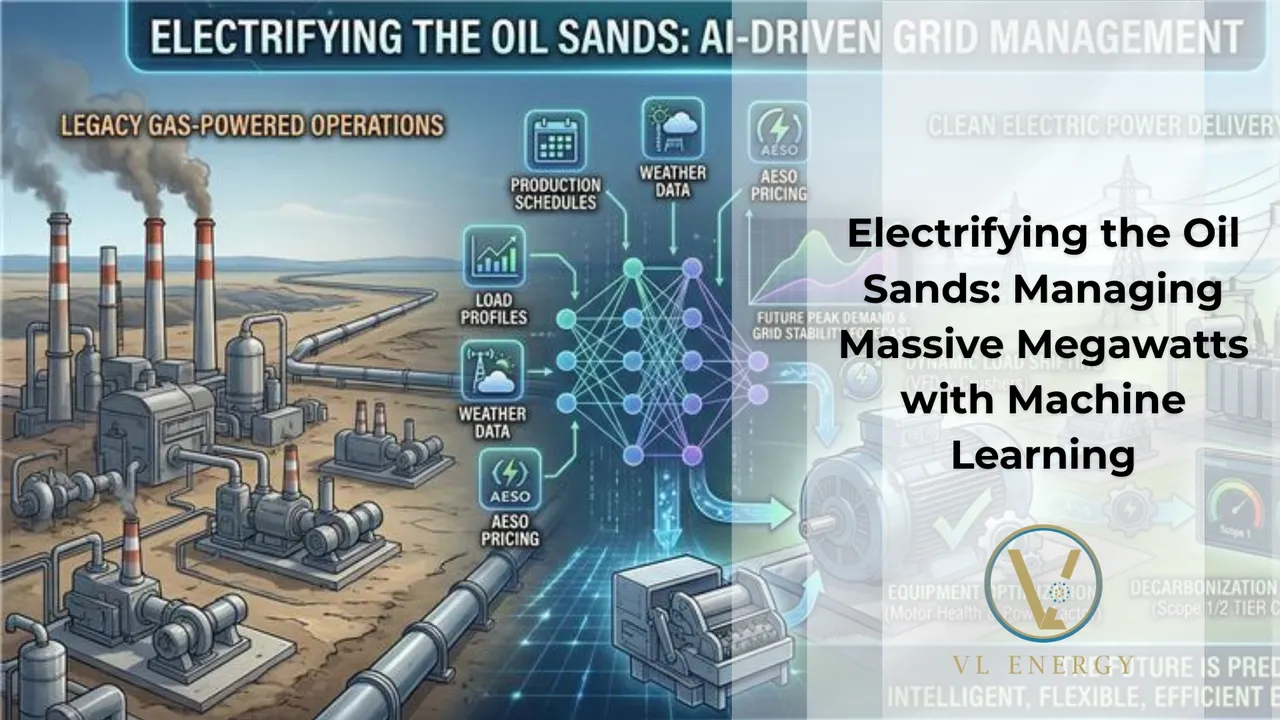
Instead of operating electrical assets reactively, ML models utilize multi-step time series forecasting to predict both facility energy consumption and external grid conditions. By continuously analyzing variables such as production schedules, historical load profiles, weather conditions, and real-time AESO pool pricing, these algorithms can accurately forecast peak demand periods hours—or even days—in advance.
From Raw Data to Actionable Energy Intelligence
The integration of ML into physical power systems transforms raw sensor data into actionable operational strategies. Here is how predictive intelligence manages the megawatt influx:
- Dynamic Load Shifting: When the ML model predicts an impending peak on the AESO grid, the EMIS can automatically recommend (or execute) load-shedding strategies. This might involve slightly reducing the speed of VFD-controlled pumps, delaying the start of large crushers, or dispatching on-site generation assets to offset the grid draw.
- Equipment Optimization: Advanced algorithms continuously monitor the electrical health of massive motors. By correlating active power (kW), reactive power (kVAR), and production output, the software ensures that motors are operating within their optimal load factors, minimizing wasted energy and maintaining a healthy power factor.
- Unified Decarbonization Tracking: As facilities run hybrid operations—balancing newly electrified equipment with legacy gas-fired processes—tracking the true carbon intensity becomes a massive data challenge. AI-driven platforms seamlessly integrate Scope 1 (direct combustion) and Scope 2 (electrical grid) emissions data, providing a verifiable, real-time dashboard for TIER compliance.
The Path Forward
True electrification in the oil and gas sector requires a deep synergy between physical electrical engineering and advanced software development. Simply adding electrical load to the grid is not sustainable; that load must be intelligent, flexible, and highly efficient.
As the energy transition accelerates, facilities equipped with predictive machine learning models will be the ones that successfully navigate grid constraints, eliminate artificial demand, and achieve their decarbonization goals without sacrificing operational reliability. The future of heavy industry isn't just electric, it is predictive.