
In today’s industrial landscape, monitoring emissions isn’t just a regulatory requirement—it’s a critical part of operational efficiency, environmental responsibility, and risk management. From power generation to oil and gas operations, operators must measure and report emissions accurately to stay compliant and avoid costly penalties.
For decades, Continuous Emissions Monitoring Systems (CEMS) have been the go-to solution. These systems use physical analyzers to directly sample flue gases and provide real-time measurements of pollutants such as NOₓ, SO₂, CO₂, and particulate matter. While highly accurate, CEMS comes with significant challenges: high capital costs, ongoing maintenance requirements, and operational complexity.
Enter Predictive Emissions Monitoring Systems (PEMS) — the next-generation approach. Instead of relying on hardware analyzers, PEMS uses advanced software and AI models to calculate emissions based on operational data such as fuel flow, temperature, pressure, and opacity. This approach delivers the same accuracy as traditional CEMS, but at a fraction of the cost, complexity, and downtime risk.
What is CEMS?
Continuous Emissions Monitoring Systems (CEMS) have long been the industry standard. They work by physically sampling exhaust gases and analyzing them with specialized equipment.
Strengths:
- Direct measurement ensures regulatory compliance.
- Real-time data is highly reliable.
Limitations:
- High capital and operational costs.
- Requires frequent calibration, maintenance, and skilled staff.
- Susceptible to analyzer downtime or failure.
What is PEMS?
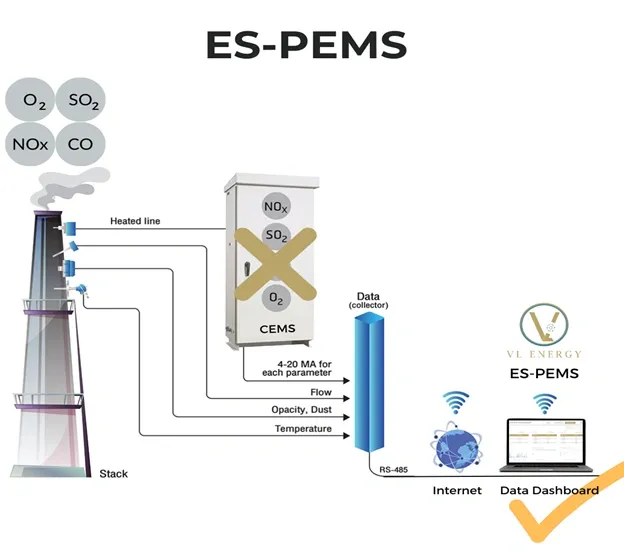
Predictive Emissions Monitoring Systems (PEMS) calculate emissions using operational data rather than direct gas sampling. By analyzing process variables such as pressure, temperature, flow rate, speed, and fuel consumption, PEMS can estimate emissions in real time.
VL Energy’s ES-PEMS takes this approach further with AI-driven models, predictive analytics, and cloud-based dashboards. Here’s how it works:
ES-PEMS Workflow
-
Data Collection: ES-PEMS collects data from:
- Existing CEMS or portable gas analyzers
- Instrumental sensor readings (pressure, temperature, flow, speed, fuel consumption, etc.)
- Optional hardware provided by VL Energy for new installations
-
Data Processing & Validation: Raw data is cleaned, validated, and integrated into the ES-PEMS AI model.
-
Predictive Modeling & Optimization: Using advanced AI algorithms, ES-PEMS calculates emissions (NOₓ, CO, CO₂, CH₄, N₂O, SOₓ, etc.), identifies operational inefficiencies, and predicts potential exceedances before they occur.
-
24/7 Real-Time Monitoring & Reporting:
- Daily, weekly, monthly, or annual dashboards accessible via web interfaces
- Compliance-ready reporting for regulators
- Actionable insights to optimize fuel use, efficiency, and emissions reductions
-
Decision Support: Operators can use the ES-PEMS outputs to improve productivity, reduce costs, and maintain continuous compliance.
Benefits of ES-PEMS
- Fully Replace CEMS: Eliminate hardware dependence while maintaining compliance.
- Increase Productivity & Efficiency: Predict and prevent operational issues before they affect output.
- 24/7 Real-Time Decision Support: Access live dashboards, trends, and predictive insights.
- Flexible Data Inputs: Compatible with existing CEMS, portable analyzers, or new VL Energy-provided sensors.
- Scalable & Future-Proof: Deploy across multiple units or facilities with minimal additional hardware.
CEMS vs ES-PEMS: Why ES-PEMS is Smarter
CEMS has been the standard for emissions monitoring, but ES-PEMS represents the next generation: accurate, predictive, and cost-effective. Developed by VL Energy, this AI/ML-powered, real-time software monitors, predicts, and reduces emissions from industrial combustion equipment—without new hardware.
Proven at scale with Suncor and Cenovus, ES-PEMS has delivered measurable reductions in fuel use, CO₂, CO, and NOₓ, while being regulator-approved by the Alberta Energy Regulator (AER) and Alberta Environment and Parks (AEP). By cutting monitoring costs by up to 70%, providing ground-truth validation for methane strategies, and improving combustion efficiency, ES-PEMS helps operators maintain compliance, optimize performance, and advance sustainability goals.
Book a demo today to see how ES-PEMS can transform your facility. Contact our team.